The Thesis
For the non-scientists in my life, I've made short and hopefully accessible overviews of my thesis chapters below!
How Destruction Creates
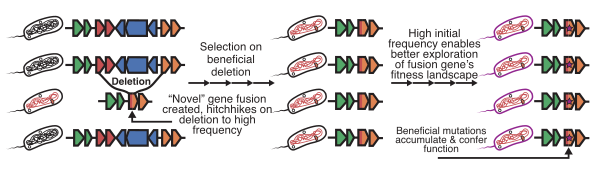
Bacteria are minimalists. Their genomes are under relentless pressure to shrink. You might think this is purely destructive. But there's a twist! When a chunk of DNA gets cut, the two loose ends get stitched back together, and sometimes those ends land in the middle of two different genes. The result is a brand-new hybrid gene that never existed before!
Even better, this new gene doesn't have to immediately be useful to survive. It can hitchhike on the benefit of the deletion itself! If the deletion helps the bacterium, the new gene can simply come along for the ride. We show that this mechanism, what we call deletion-born fusion genes, is used to generate genes across the bacterial tree of life. The very force that destroys genes is also one of the engines that creates them.
Antibiotics Didn't Create Resistance, It Amplified It.
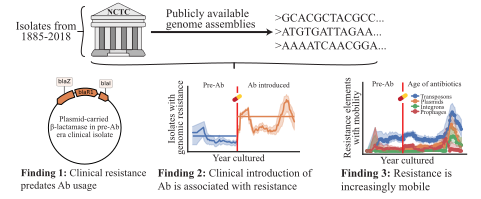
Here's a popular misconception: that antibiotic resistance is something we caused. In reality, Nature has been producing antimicrobial compounds and evolving resistance to them for billions of years, long before humans used them in the clinic. When scientists look at bacterial samples preserved since the 1800s, they can already find resistance genes sitting quietly in the genome, rare and mostly harmless.
But everything changed when the humans attacked. After the introduction and widespread disemmination of antibiotics, those rare resistance genes became common. And they jumped onto mobile genetic elements (think of them as tiny biological USB drives that bacteria can swap with each other) making resistance spread far faster and farther than before. We traced this transformation using over 1,800 bacterial genomes spanning 140 years of history. The conclusion: we didn't invent resistance, but we made it more frequent and more mobile.
Drawing Maps of Bacterial Evolution
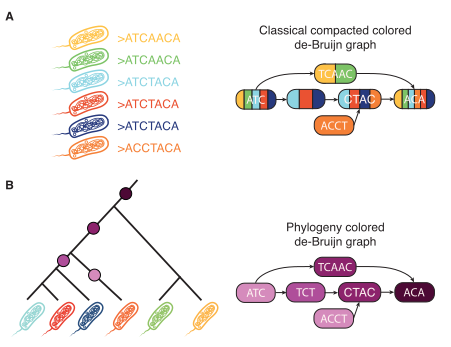
When we sequence lots of bacterial genomes, how do you make sense of it all? Standard tools can tell you which bacteria share a piece of DNA, but not when or how that piece moved through the bacterial family tree.
This chapter introduces a new kind of data structure, a phylogeny-colored de Bruijn graph, that overlays evolutionary history directly onto the genome sequence. Instead of just knowing that two bacteria share a stretch of DNA, you can now see exactly which branch of the family tree it came from, and pinpoint the boundaries where one evolutionary history ends and another begins. Applied to over 1,000 MRSA genomes, the method automatically recovers the known landscape of mobile genetic elements, all without any prior annotation!
If you want to read the FULL thing, you can find it here.
Download Thesis (PDF)